Perfect pitch
Pitch
Hear one note and name it. Start with C and G, finish with all twelve notes in any octave.
CGEF♯B
Train your ear in 5 minutes a day. Short lessons on a real grand piano take you from single notes to full chord progressions, one sound at a time.


You can play a song once someone shows you where your fingers go. Hear a riff you like, though, and you're back to searching "chords for…". That's not a talent problem. Your eyes got all the training. Your ears got none.
Nobody is born reading chords off a recording. It's trained.
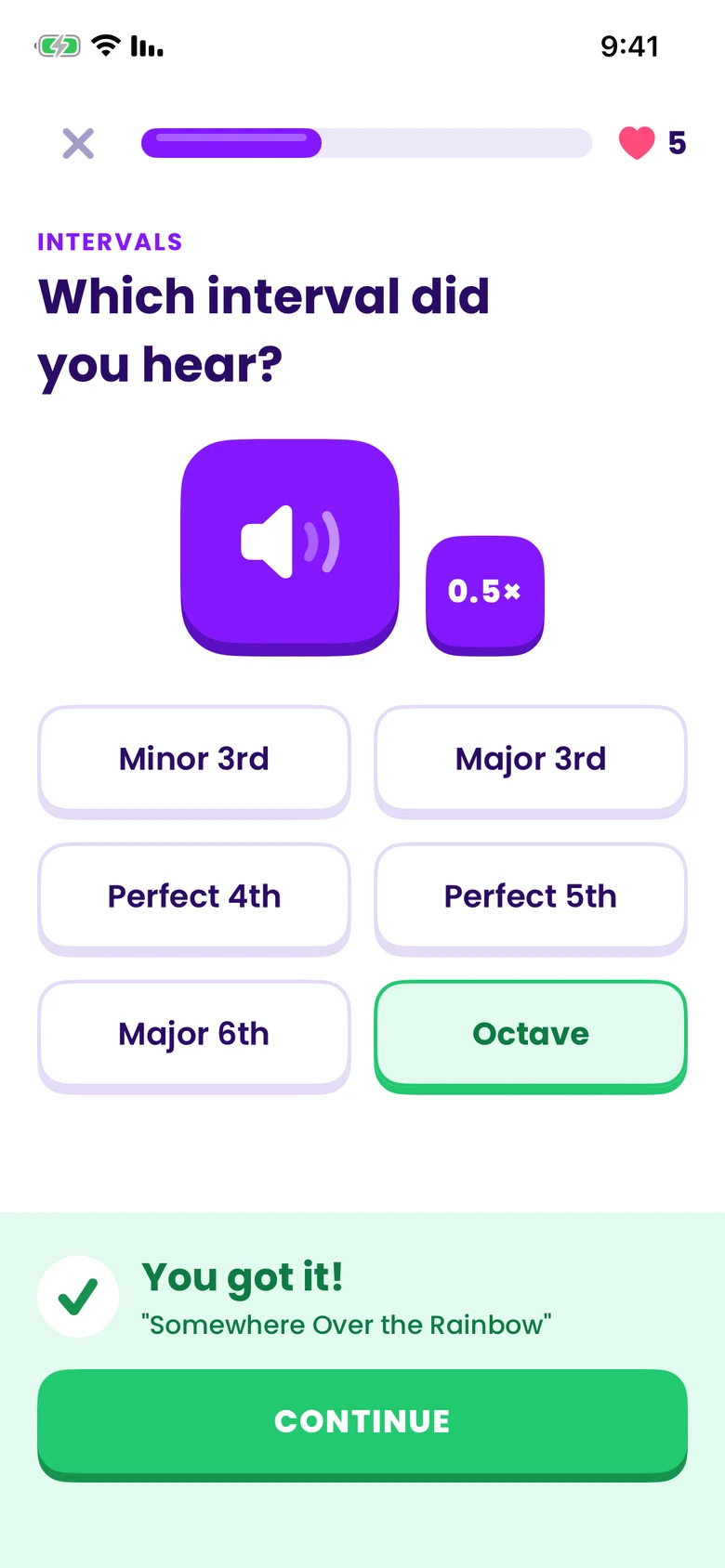
Tap play and a real grand piano plays a note, an interval, a chord, a progression or a scale. Too quick? Hit 0.5×.
Right answers earn XP. A wrong one costs a heart, and that question comes back before the lesson ends.
Every new sound comes with a hook from a song you already know. Then tap any answer to hear it next to the right one.
Each skill starts with just two sounds and adds more as you get them right.
Hear one note and name it. Start with C and G, finish with all twelve notes in any octave.
Hear the distance between two notes, going up, going down or played together. Minor 2nd all the way to the octave.
Major or minor first. Then diminished, augmented, sus chords and the sevenths that make jazz sound like jazz.
The chord moves behind pop, rock and jazz. Hear where a song is going before it gets there.
Major, the three minors, pentatonic, blues and the modes. Bright, dark, bluesy or Spanish, you'll know it.
Ten sounds pulled from every skill you've started, so the old ones stay sharp while you learn new ones.
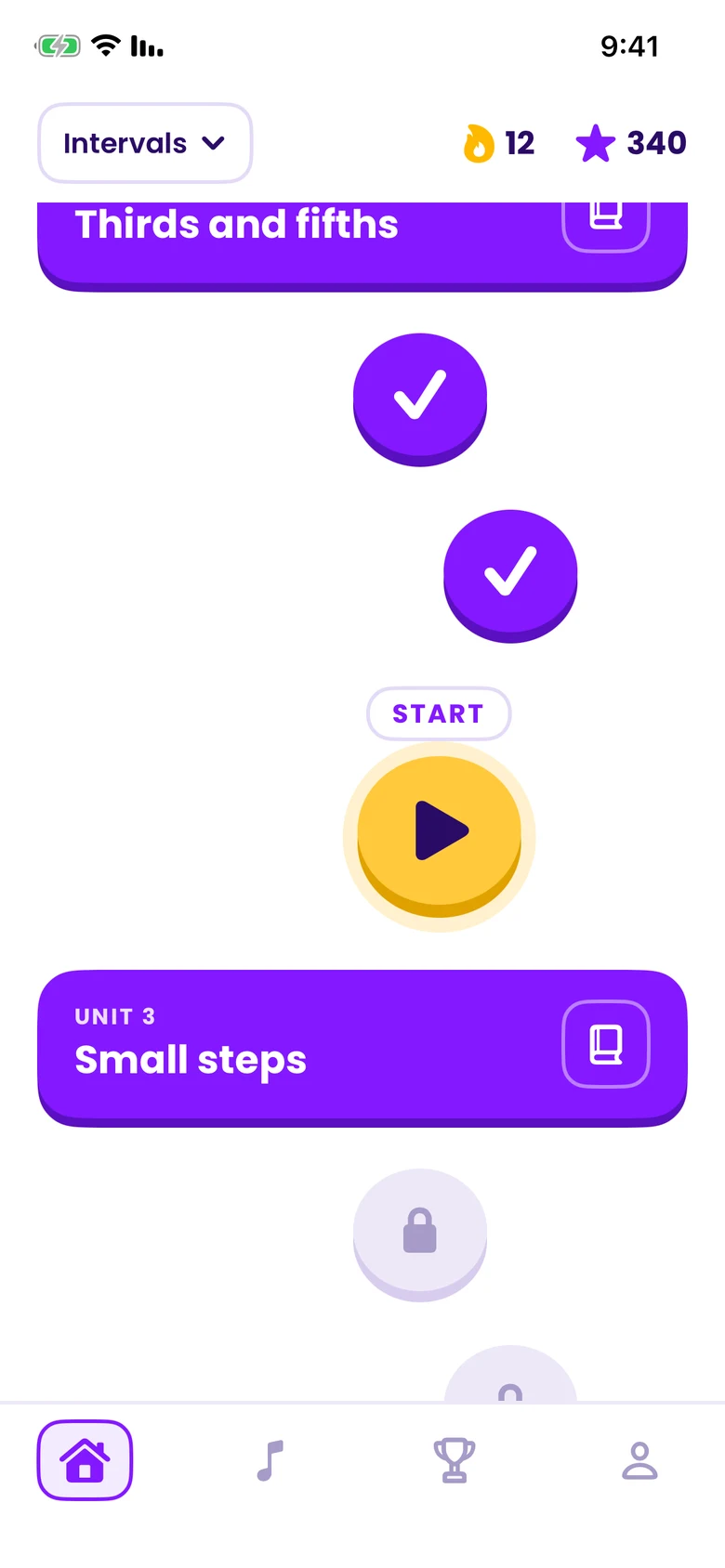
Short lessons in order. Finish one and the next one opens.
Practice once a day to keep the flame going. Pick 5 to 20 minutes and get a daily reminder.
10 XP a lesson, 5 more if you don't miss a single one.
Five per lesson. Run out and you start over, so you listen instead of guessing.
The app keeps score of the sounds you miss most and drills just those.
Accuracy for every skill, today's goal and your week at a glance.
Ear training is pattern recognition. Patterns stick when you meet them often, in small doses, and hear them side by side. That's the whole method.
Old sounds keep coming back in new lessons and daily workouts, so they don't fade while you learn the next ones.
A minor 3rd makes the most sense right next to a major 3rd. After every answer you can play the options back to back.
You hear a sound before you learn its name. Theory stays to one line and a song you already know.
Ten questions take a few minutes. A session you finish every day beats a long one you keep putting off.
No made-up studies here. Try it for days and judge with your own ears.
The same prices you'll see in the app. Try the yearly plan free for days.
days free, then about a week
Billed every week. No trial.
Payment is charged to your Apple ID or Google Play account. Subscriptions renew automatically until you cancel. On iPhone, cancel at least 24 hours before the trial or current period ends to avoid the next charge; on Android, cancel any time before it ends. Prices are in USD and may differ by country. See the Terms.
Both. The Pitch skill drills naming single notes with no reference, which is what people mean by perfect pitch. Intervals, chords, progressions and scales train relative pitch: hearing how notes relate to each other. Relative pitch is what most musicians use to play by ear.
Straight talk: adults can get a lot better at naming notes, but whether an adult can build full perfect pitch is still debated. We won't promise it.
No. Every sound gets a plain name and a hook from a song you know. You never have to read sheet music.
None. The app plays a sampled grand piano and you tap your answers. What you train carries over to guitar, piano, bass, voice, producing, whatever you play.
A lesson is 10 questions and takes a few minutes. You set a daily goal of 5, 10, 15 or 20 minutes. Five a day is a good start.
The first lessons only ask you to tell two sounds apart, so you'll get answers right on day one. After that it depends on where you start and how often you practice. Five minutes every day beats an hour once a week.
Yes. The piano lives inside the app, so lessons work on a plane or in a basement. You only need a connection to start or restore a subscription.
The download is free. Training needs a subscription: yearly at with days free, or weekly at . Those are the real prices, listed right here before you download.
On iPhone: Settings → your name → Subscriptions → → Cancel. Do it at least 24 hours before your trial ends and you pay nothing.
On Android: open Google Play, tap your profile picture → Payments & subscriptions → Subscriptions → → Cancel.
We send a reminder before the trial runs out.
Yes. No ads, no chat, no account to create. If your kid can read the answer buttons, they can play. A parent should set up the subscription.
Yes. It's coming to both Google Play and the App Store, with the same lessons on each. On iPhone you'll need iOS 17 or later.
Five minutes a day, ten questions at a time. Start with days free.
Then /year. Cancel anytime.